Choosing the right Berry Harvester is no longer a simple equipment purchase. It is a production decision involving fruit quality, labor availability, field conditions, and long-term operating costs. USDA’s National Agricultural Statistics Service, in its 2023 Noncitrus Fruits and Nuts Summary, tracks crop production, prices, and value across major U.S. fruit sectors. These figures show why harvesting efficiency matters when margins can change with yield and market prices.
Labor is another critical factor. USDA Economic Research Service reports regularly identify hired labor, machinery, fuel, and maintenance as significant farm-production costs. A suitable Berry Harvester can reduce repetitive hand work, but it cannot correct weak crop spacing or poorly timed harvesting. The machine must match the berry type, row width, terrain, and ripeness pattern. Small details matter. A narrow row may prevent damage. A gentle conveyor may protect soft fruit. Easy cleaning can reduce downtime between fields.
FAOSTAT production data also places berries within a rapidly expanding global fruit industry, where quality, consistency, and supply reliability influence buyer confidence. Yet published market forecasts should be treated carefully. They often use different definitions and assumptions. A machine that performs well on blueberries may disappoint in raspberries or blackberries. No machine is perfect. The best choice depends on evidence from field trials, operator feedback, service support, and measurable harvesting losses. This guide examines those criteria closely, helping growers compare capacity, fruit handling, labor savings, maintenance demands, and total ownership cost before committing capital. The decision may still involve uncertainty, but it should not rely on attractive brochures alone.
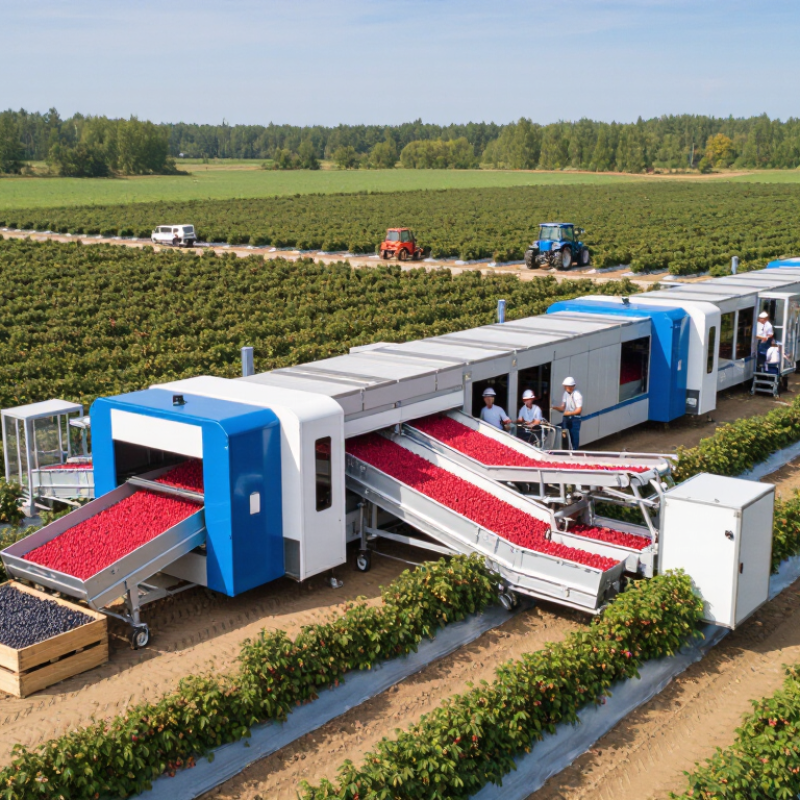
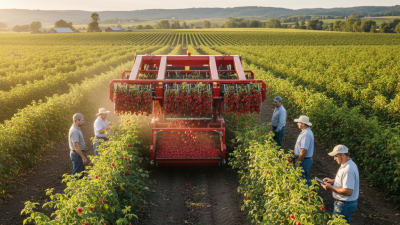
A berry harvester is a machine that removes ripe fruit from plants with controlled shaking. For blueberries, rotating or vibrating rods contact the branches gently. The berries fall onto catching plates, then move through conveyors into field bins. Airflow and screens can remove leaves, stems, and light debris. Some machines use optical sorting, but field cleaning is never perfect.
Scale matters. FAOSTAT reported global strawberry production above 9 million tonnes in 2022, showing the pressure on harvesting systems. Yet strawberries usually require different equipment because their fruit grows close to the ground. USDA NASS’s 2023 Noncitrus Fruits and Nuts Summary tracks berry acreage, yield, production, and value, useful measures when estimating machine capacity. Choose equipment according to crop type, row spacing, terrain, and fruit firmness. A faster shaker may increase bruising. A slower setting may leave ripe berries behind. In practice, operators should test several vibration speeds, inspect fruit after collection, and compare labor savings against damaged produce. This step is often skipped. It should not be.
A berry harvester uses vibrating or rotating picking elements to detach ripe fruit, while conveyors and collection systems transport the berries into bins. The chart compares typical operating ranges used when evaluating machine suitability for different berry crops.
Blueberries are generally the most suitable for mechanical harvesting because firm fruit and relatively uniform ripening support higher field capacity. Raspberries and blackberries require gentler handling because soft fruit can be damaged more easily. Actual results depend on cultivar, row spacing, terrain, ripeness, machine settings, and whether fruit is intended for fresh or processing markets.
Choosing the best berry harvester starts with berry biology, not engine power. Each crop demands a different harvesting approach.
The USDA National Agricultural Statistics Service reported more than 1.3 billion pounds of U.S. strawberries in its 2023 summary. Blueberry production reached roughly 700 million pounds. These figures show scale, not machine compatibility. A self-propelled over-row harvester can suit firm, evenly ripened blueberries for processing. It may bruise soft fruit destined for fresh markets. Strawberries often need platform assistance or gentle semi-mechanical picking. Raspberries and blackberries require even more care because their drupelets detach easily. Small damage becomes visible within hours.
Harvesting conditions matter just as much as berry type. Measure fruit firmness, detachment force, stem retention, canopy height, and row spacing before buying equipment. Check fields after morning dew disappears. Wet leaves increase contamination and reduce visibility. Uneven ground also affects picking consistency. A machine that performs well on flat soil may struggle on slopes or compacted beds.
Cold-chain planning must follow harvest speed. UC Davis Postharvest Technology Center guidance places many berries near 0°C with high relative humidity. That requirement makes rapid cooling essential. Test several rows first. Record bruised fruit, missed berries, labor hours, and fuel use. I would not trust a brochure alone. A trial can expose costly weaknesses. My first choice can still be wrong. Weather, cultivar, and market destination may change the answer.
Choosing a berry harvester starts with crop behavior, not machine size. Over-row harvesters suit uniform, trellised canopies and continuous field work. Catch-frame systems can protect delicate fruit during collection. Trunk shakers may deliver higher throughput, but they need compatible cultivars and firm ground. Compare kilograms per hour, marketable yield, bruising, fuel use, and labor hours. USDA NASS, in its 2023 Noncitrus Fruits and Nuts Summary, recorded more than 700 million pounds of U.S. blueberry production. That scale makes small efficiency losses expensive.
Tips: Request test data for your cultivar, row spacing, and slope. Measure saleable fruit, not only total harvest weight. Inspect berries after two hours, then again after 24 hours. Check adjustment time, cleaning access, sensor accuracy, and operator visibility. A machine that runs fast but bruises fruit is not efficient.
Performance should be judged across a full season. Record uptime, missed berries, damage percentage, maintenance minutes, and labor replacement. USDA ERS’s 2024 Farm Labor report places U.S. hired farm labor expenses above 40 billion dollars in 2022. Automation reduces some labor, but it does not remove every worker. It shifts work toward setup, inspection, and maintenance. That shift matters. I would question impressive demonstrations; perfect rows rarely represent wet soil, uneven ripeness, or tired operators. Independent university trials and multi-day field records provide stronger evidence than one showroom figure. The best choice may be slower, gentler, and more dependable.
| Harvester Type | Operating Principle | Best-Suited Crops and Conditions | Typical Field Capacity | Fruit Handling | Labor Requirement | Terrain and Orchard Requirements | Relative Purchase Cost | Key Advantages | Main Limitations | Overall Fit |
|---|---|---|---|---|---|---|---|---|---|---|
| Manual Berry Rake or Comb | Hand-operated combs or rakes remove ripe berries from the fruiting stems. | Small plantings, trial blocks, wild berries, and specialty harvesting where selective picking is important. | Low; output depends heavily on worker skill, crop density, and berry ripeness. | ★★★★★ Usually the gentlest option when used carefully. |
Very high; requires one worker per tool. | Works on uneven ground and narrow rows with minimal infrastructure. | Low | Low initial investment, simple operation, high selectivity, and easy maintenance. | Slow production, high labor cost, and physically demanding work. | Best for small-scale or highly selective harvesting. |
| Handheld Powered Shaker | A small engine or electric motor vibrates a rod, comb, or contact arm near the fruiting branches. | Small to medium plantings, wild blueberry areas, and farms without tractor access. | Low to moderate; generally faster than manual picking but highly dependent on plant structure. | ★★★★☆ Can be gentle when vibration intensity and contact are controlled. |
High; typically requires an operator and separate collection labor. | Suitable for irregular terrain and narrow access areas. | Low to medium | Portable, flexible, and less expensive than tractor-mounted equipment. | Limited throughput, operator fatigue, and possible stem or foliage damage if misused. | Best for flexible harvesting on smaller or difficult-to-access blocks. |
| Tractor-Mounted Over-Row Harvester | A tractor-powered machine passes over the row and uses rotating or reciprocating rods to dislodge ripe fruit. | Blueberries and other compatible berries planted in uniform, machine-accessible rows. | Moderate to high; working speed is commonly limited by fruit maturity, row condition, and ground speed. | ★★★☆☆ Good when fruit is evenly ripe and machine settings are correctly adjusted. |
Moderate; often needs a tractor operator plus workers for quality control and handling. | Requires consistent row spacing, adequate headland space, suitable plant height, and firm traffic lanes. | Medium to high | Uses an existing tractor, offers greater throughput than handheld systems, and can be configured for different rows. | May require multiple passes, can increase bruising if poorly adjusted, and needs compatible orchard geometry. | Best value for medium-sized farms with suitable row structure. |
| Self-Propelled Over-Row Harvester | A dedicated machine straddles the crop row and mechanically removes berries while traveling through the field. | Commercial blueberry and other berry plantations with uniform plantings and sufficient acreage. | High; designed for continuous field harvesting and reduced manual handling. | ★★★☆☆ Performance depends on shaker design, fruit maturity, cushioning, and conveyor settings. |
Low to moderate; commonly requires an operator and receiving or quality-control personnel. | Needs level or well-prepared ground, consistent row spacing, adequate turning areas, and sufficient plant clearance. | High | High productivity, consistent harvesting action, reduced dependence on seasonal picking labor, and integrated conveyors or cleaning systems. | High capital cost, specialized maintenance, transport considerations, and less flexibility in irregular fields. | Best for large commercial farms focused on mechanical harvesting efficiency. |
| Side-Row or Pull-Behind Shaker | A tractor-towed or side-positioned mechanism shakes or combs fruiting branches from beside the crop row. | Selected berry orchards where full over-row clearance is unavailable or where side access is preferred. | Moderate; affected by row layout, plant form, and the number of passes required. | ★★★☆☆ Can provide balanced handling if branch contact and vibration are controlled. |
Moderate; normally requires a tractor operator and collection labor. | Requires accessible row sides, suitable tractor lanes, and enough space to maneuver beside plants. | Medium to high | May fit existing orchards that cannot accommodate a full over-row machine and can offer easier maintenance access. | Less suitable for dense, irregular, or heavily branched plants; may require more precise alignment. | Best when row-side access is available but over-row harvesting is impractical. |
| Selective Robotic or Vision-Assisted Harvester | Cameras, sensors, robotic arms, or automated grippers identify and remove fruit based on ripeness and position. | High-value fresh-market berries and controlled production systems where selective picking is essential. | Variable; current systems are generally specialized and depend strongly on crop geometry and ripeness uniformity. | ★★★★☆ Potentially gentle, but results depend on gripper design and software calibration. |
Low to moderate after setup, with technical supervision and system monitoring still required. | Requires highly uniform plants, predictable lighting, accessible fruit, and carefully managed rows. | Very high | Selective harvesting, reduced direct labor, data collection, and potential integration with precision-farming systems. | High investment, complex maintenance, limited crop compatibility, and sensitivity to plant variability. | Best for specialized operations and future-oriented automation projects. |
A good berry harvester should match the crop, field, and daily work rhythm. Start with capacity, not advertised speed. Measure kilograms collected per hour under real field conditions. A machine that moves quickly but causes jams may reduce output. Check hopper size, unloading time, and access between rows. Narrow lanes can make a high-capacity model surprisingly inefficient.
Crop safety needs close inspection. Ask for trial results on your berry variety and maturity stage. Look for gentle contact points, adjustable shaking, and clean fruit separation. Watch the berries during a test run. Bruising may appear hours later, which is easy to miss.
Tips: Bring a sample crate, record damaged fruit, and compare losses after one day. Do not rely only on a sales demonstration.
Labor and maintenance often affect harvest costs more than expected. Count operators, loading tasks, cleaning time, and routine adjustments. Clear controls reduce training, but simple controls do not guarantee safe operation. Inspect belts, bearings, guards, and wash-down access before purchase. Ask how quickly common parts can be replaced locally. I once underestimated cleaning time. That mistake mattered. A realistic maintenance log can reveal hidden labor costs. Also review noise, vibration, visibility, and emergency stops with the crew. Their feedback is practical evidence, not an afterthought.
When selecting a berry harvester, start with your actual budget, not the machine’s advertised price. I have seen growers overlook transport, seasonal servicing, fuel, and operator training. These costs can quietly exceed the initial payment. Write down your harvest area, expected yield, and available labor. Then compare the machine’s total cost over five seasons.
A compact harvester may suit a small farm with narrow rows and uneven ground. It can cost less to move and maintain. However, slower harvesting may increase fruit loss during hot weather. A larger machine may reduce labor hours, but it needs wider headlands and stronger cash flow.
Ask for hourly capacity measured with your berry type, row spacing, and crop density. General figures are not enough. Request a field demonstration when possible.
Buying used equipment can protect your budget, but inspect the shaker, conveyors, belts, bearings, and safety guards carefully. Check service records and replacement-part availability. A low purchase price is not automatically a low operating cost. I would also reserve money for unexpected repairs, because harvest equipment rarely fails at a convenient time. My first estimate would be too optimistic. Recheck it with a mechanic and a grower who uses similar terrain. Consider renting during one harvest before committing to ownership. That trial may reveal hidden labor demands, awkward controls, or cleaning time that a spreadsheet misses.
A&B has become the leader in fresh packing and cleaning equipment for fruits and vegetables worldwide. We have achieved this by relentlessly working to produce new and innovative ideas, along with the best customer service on Earth combined with hard working, dedicated, loyal employees and the latest industrial manufacturing techniques. We are now proud to say that we manufacture The Fulcrum Fresh Harvester, this is a one of a kind Berry Harvester that was specifically designed to handle fresh pick blueberries.
732 W. Saint Joseph Street
Lawrence, MI 49064
Phone: 269-539-4700 Fax: 269-539-4705
sale@industrialpackagingmachines.com