Choosing the right Plastic Food Container is rarely a simple matter of price, shape, or color. Global buyers must examine food-contact suitability, temperature resistance, sealing performance, durability, and recycling conditions. A clear polypropylene container may suit hot meals, while a lightweight polyethylene container may perform better for chilled produce. PET can offer excellent visibility, but it may not suit every heating application. Details matter.
Dr. Jane Muncke, Managing Director of the Food Packaging Forum, has warned that “food packaging should protect food without creating unnecessary chemical exposure.” Her perspective gives this topic a practical direction. A reliable container should protect food while limiting avoidable migration risks, odor transfer, leakage, and premature cracking. Buyers should request technical data, test reports, and traceability records from qualified suppliers. Product samples still matter. A catalog cannot reveal how a lid behaves after repeated washing or how a container performs inside a crowded export carton.
This 2026 guide compares common Plastic Food Container types for international purchasing teams. It considers material properties, food applications, customization, logistics, and end-of-life concerns. No material wins every test. That is easy to forget. Some reusable containers become waste when their lids fail early. Some recyclable designs remain difficult to process locally. Regional infrastructure also changes the practical value of a material. Careful buyers should question attractive claims, inspect real samples, and match container performance with actual storage conditions. The best choice is not always the newest polymer or the cheapest quote. It is the container that remains safe, functional, and commercially dependable throughout its intended service life.
Plastic Food Container Materials and Their Key Properties
Choosing a plastic food container starts with the material, not the shape. Polypropylene, or PP, handles heat well and resists many oils, making it practical for meal preparation and reheating. High-density polyethylene, known as HDPE, is tough, lightweight, and suitable for chilled foods. It often feels less flexible than other options. Polyethylene terephthalate, or PET, offers good clarity and stiffness. It works well for cold foods and displays, but high heat can deform it. Low-density polyethylene is soft and flexible, although it may not provide strong stacking support.
Material selection also depends on temperature, food acidity, storage time, and transport conditions. A container for tomato sauce needs different resistance than one for dry grains. In sourcing reviews, buyers sometimes focus on price and forget lid performance. That mistake can cause leakage, odors, or wasted stock. I have also seen clear plastic chosen for appearance, even when light-sensitive foods needed better protection. Supplier declarations, migration test reports, and food-contact documentation should match the destination market. Requirements may differ across regions, so assumptions are risky.
Tips: Test the container with the actual food, lid, and temperature cycle. Check whether the material is approved for its intended use. Measure stacking strength after refrigeration. Inspect samples for warping, stains, and lingering odors. Do not trust appearance alone. A slightly imperfect sample can reveal a serious production issue.
Plastic food containers serve different purposes, and one material cannot meet every need. Polypropylene containers suit meal preparation, soups, and reheating when marked microwave-safe. They tolerate repeated use and moderate heat. Polyethylene containers work well for flexible pouches, freezer storage, and lightweight lids. High-density polyethylene offers strong protection for dry foods, sauces, and larger storage tubs. Polyethylene terephthalate containers provide clear visibility for salads, fruit, and chilled products. They are usually better for cold applications than high-heat use.
Clear deli-style containers support quick product identification and stack efficiently in catering operations. Airtight containers help protect grains, snacks, and powdered ingredients from moisture. Small portion cups fit sauces and samples, while deep containers reduce spills during transport. Buyers should compare wall thickness, lid fit, temperature range, and stacking strength. A container may look sturdy but still warp under heat. That detail is easy to miss.
2026 Best Plastic Food Container Types for Global Buyers
Safety begins with the intended food, temperature, and contact time. Polypropylene suits hot meals and repeated household use, while high-density polyethylene works well for cold storage. Polyethylene terephthalate is common for clear containers, but it is not ideal for high-heat cooking. Material choice matters.
The OECD Global Plastics Outlook reports that global plastic production reached 460 million tonnes in 2019, with packaging as the largest use sector. This scale increases the need for traceable food-contact controls. Buyers should request a Declaration of Compliance, migration test results, resin identification, and production-lot records. In the European Union, Regulation (EU) No 10/2011 sets plastic food-contact requirements, including an overall migration limit of 10 mg per square decimetre. Specific substances may have stricter limits. United States buyers should also verify compliance with applicable food-contact provisions under Title 21 of the Code of Federal Regulations.
Check the container, lid, gasket, and printed surface separately. The weakest component can affect the whole package. Ask whether testing covered acidic sauce, oily food, freezing, and repeated heating. A container that survives one laboratory cycle may perform differently after months of washing. I have seen specifications that looked complete but omitted lid testing. That gap deserves attention. Suppliers should provide test dates, laboratory accreditation, simulants used, and clear temperature limits. “Food grade” alone is not enough.
Comparison guide for selecting reusable and single-use plastic food containers according to material performance, food-contact compliance, temperature conditions, and end-use requirements.
| Plastic Type | Common Resin Code | Main Strengths | Typical Temperature Guidance | Suitable Food Applications | Microwave Use | Dishwasher Use | Global Food-Contact Compliance References | Recyclability Considerations | Buyer Safety Checklist |
|---|---|---|---|---|---|---|---|---|---|
| Polypropylene (PP) | ♻ 5 | Lightweight, durable, good chemical resistance, and strong resistance to repeated heating compared with many other food-contact plastics. | Many food-grade PP products are designed for approximately 0°C to 100°C, with some products rated for higher temperatures. Always follow the supplier's tested limit. | Meal-prep boxes, lunch containers, storage tubs, takeaway containers, yoghurt cups, and food-service packaging. | Commonly suitable when labeled | Commonly suitable when labeled | EU Regulation (EC) No. 1935/2004; EU Regulation (EU) No. 10/2011; United States FDA 21 CFR 177.1520 may apply to compliant polypropylene articles; local requirements must also be checked. | Widely accepted in many recycling systems, but acceptance varies by country, sorting facility, color, additives, and product format. | Confirm food-contact grade, migration testing, heating instructions, lid compatibility, and traceability of resin and additives. |
| High-Density Polyethylene (HDPE) | ♻ 2 | Good moisture barrier, impact resistance, chemical resistance, and low-temperature performance. | Often used from below-freezing conditions up to approximately 80°C for many containers; exact limits depend on design and testing. | Milk bottles, juice containers, food buckets, dry-food storage, condiment bottles, and freezer-compatible packaging. | Usually not recommended unless labeled | Product-specific | EU Regulation (EC) No. 1935/2004; EU Regulation (EU) No. 10/2011; United States FDA food-contact regulations may apply, including relevant polyethylene provisions under 21 CFR. | Commonly recyclable where HDPE collection exists. Natural or unpigmented HDPE is generally easier for sorting and recycling than heavily colored formats. | Check maximum filling temperature, hot-food suitability, odor and flavor transfer testing, and freezer-use instructions. |
| Low-Density Polyethylene (LDPE) | ♻ 4 | Flexible, lightweight, moisture resistant, and effective for squeeze or film-style packaging. | Typically suitable for chilled or ambient use; many products are not intended for high-heat applications. Confirm the tested range before use. | Flexible lids, freezer bags, food pouches, squeezable bottles, liners, and flexible food packaging. | Generally unsuitable unless specifically labeled | Generally unsuitable unless specifically labeled | EU Regulation (EC) No. 1935/2004; EU Regulation (EU) No. 10/2011; applicable United States FDA food-contact requirements for polyethylene materials. | Recycling availability is often limited for films and flexible formats. Clean, separately collected film may require dedicated recycling programs. | Verify seal integrity, puncture resistance, migration results for fatty foods, and whether the item is designed for direct food contact. |
| Polyethylene Terephthalate (PET/PETE) | ♻ 1 | Clear, lightweight, strong, and provides good gas and moisture barrier performance for many applications. | Best suited to chilled or ambient conditions unless the product is specifically engineered and tested for hot filling or heat treatment. | Water and beverage bottles, salad containers, fruit trays, bakery packaging, and clear food jars. | Not normally suitable | Usually not recommended | EU Regulation (EC) No. 1935/2004; EU Regulation (EU) No. 10/2011; United States FDA 21 CFR 177.1630 may apply to compliant PET articles. | One of the most widely collected food-packaging plastics. Clear, clean, single-polymer PET is generally preferred for high-quality recycling. | Do not assume a PET bottle is reusable or heat resistant; confirm intended-use testing, hot-fill rating, and closure compatibility. |
| Polystyrene (PS) | ♻ 6 | Rigid PS offers clarity and stiffness; expanded PS provides low weight and thermal insulation. | Generally intended for cold or room-temperature foods. Heat resistance is limited, especially for expanded PS products. | Cold-food cups, trays, disposable containers, bakery packs, and protective food-service packaging where permitted. | Generally unsuitable | Generally unsuitable | Food-contact compliance depends on formulation and market. Check EU Regulation (EU) No. 10/2011, applicable national restrictions, and United States FDA requirements. | Collection and recycling are limited in many regions, particularly for expanded polystyrene contaminated with food residue. | Review local bans or restrictions, avoid hot or oily foods unless expressly tested, and confirm styrene-migration compliance. |
| Polycarbonate (PC) | ♻ 7 or other | Rigid, transparent, impact resistant, and capable of repeated use in demanding applications. | Can tolerate higher temperatures than many commodity plastics, but the actual limit depends on the grade, additives, and container design. | Reusable water dispensers, durable food-service containers, and selected high-impact reusable products. | Only when labeled and tested | Product-specific | Confirm compliance with EU Regulation (EU) No. 10/2011 and applicable national rules. For the United States, verify the specific resin and intended use under FDA food-contact regulations. | Recycling is less consistently available than for PET, HDPE, or PP. Material identification may be grouped under code 7. | Request documentation for bisphenol-related restrictions, overall and specific migration, repeated-use testing, and temperature cycling. |
| Acrylonitrile Butadiene Styrene (ABS) | ♻ 7 or other | Strong, rigid, and impact resistant with good dimensional stability. | Generally intended for ambient or moderate-temperature use; it is not a default choice for hot-food contact. | Container components, clips, handles, organizers, and selected food-contact parts when the specific formulation is approved. | Generally unsuitable unless specifically approved | Generally unsuitable unless specifically approved | Food-contact suitability is formulation-specific. Confirm compliance with the destination market's positive-list, migration, and compositional requirements. | Recycling infrastructure is limited and often depends on local collection and sorting capabilities. | Do not treat general-purpose ABS as food-contact safe; obtain a food-contact declaration and testing for the exact grade and colorant. |
| Polyamide (PA/Nylon) | ♻ 7 or other | High mechanical strength, abrasion resistance, and useful barrier properties in multilayer packaging. | Temperature performance varies significantly by grade and moisture exposure; follow the supplier's tested conditions. | Food-processing components, barrier films, multilayer packaging, and selected reusable utensils or containers. | Only when labeled and tested | Product-specific | Verify compliance with EU Regulation (EU) No. 10/2011 and the relevant food-contact rules in the importing country. | Recycling is developing but less standardized than for PET, HDPE, and PP; multilayer structures can be difficult to recycle. | Check moisture-conditioning tests, migration into fatty foods, multilayer compatibility, and repeated-use durability. |
| Biodegradable or Compostable Plastics, such as PLA | Often ♻ 7 or material-specific | Can support renewable-feedstock or compostable-packaging claims when the complete product meets the required certification. | PLA is commonly intended for cold or ambient foods and may deform at relatively low heat. Exact performance depends on formulation and design. | Cold beverages, fresh produce, salad boxes, cups, and short-life food-service packaging where suitable. | Generally unsuitable | Generally unsuitable | Food-contact compliance is separate from compostability. Check applicable food-contact laws plus compostability standards such as EN 13432, ASTM D6400, or equivalent certification for the complete product. | Industrial compostability does not mean home compostability or recyclability. Collection and processing facilities must exist in the target market. | Verify food-contact migration, compostability certification, disposal instructions, coating composition, and restrictions on environmental claims. |
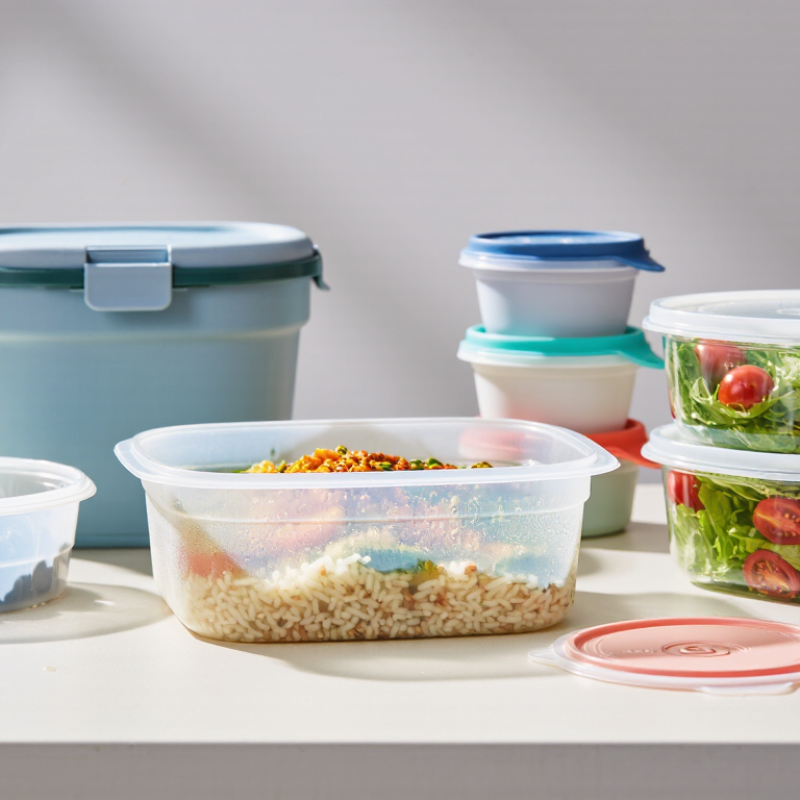
Choosing plastic food containers for global trade requires more than comparing volume and price. Storage, transport, and retail create different stresses. A warehouse may need stackable, light-blocking containers, while a delivery route demands impact resistance and leak control. The 2023 OECD Global Plastics Outlook projects annual plastic waste could reach 1,014 million tonnes by 2060 under current policies. That pressure makes material efficiency important, but thinner is not always better.
For storage, check wall thickness, closure torque, temperature tolerance, and odor retention. For transport, run drop, vibration, compression, and seal tests with filled containers. A container that survives an empty-box test may fail after six hours in a hot truck. Retail containers also need clear labeling areas, stable shelves, tamper evidence, and consistent dimensions. Small details matter. The UN Environment Programme’s 2023 report identifies packaging as a major driver of plastic demand and recommends reuse, redesign, and improved recycling systems.
Material selection should match the food and destination market. Polypropylene often suits reheating applications, while polyethylene can support flexible, impact-resistant formats. However, performance varies by grade and manufacturing process. Request food-contact declarations, migration test results, recycled-content documentation, and batch traceability from suppliers. Requirements differ across jurisdictions, so one certificate may not cover every destination. I have seen buyers focus too heavily on unit price and overlook pallet efficiency, damaged-goods rates, and return handling. That calculation needs a second look. The cheapest container can become expensive when lids warp, labels peel, or cartons collapse.
For global buyers, plastic food containers should be judged beyond appearance. In sourcing reviews, check wall thickness, lid fit, odor, and clarity before discussing price. A strong container survives repeated opening, stacking, and transport vibration. It should protect food from leaks and unwanted flavor transfer. Material selection matters. Polypropylene suits many hot-fill and reheating applications. Polyethylene often performs well for flexible, lightweight storage. These are practical starting points, not universal answers. Temperature limits must come from verified technical data.
Compliance requires documented evidence, not confident promises. Ask for food-contact declarations, migration test reports, batch traceability, and clear labeling information. Requirements differ across destination markets, especially for additives, recycled content, and microwave use. An experienced supplier should explain test methods and provide current documents. Do not accept a generic certificate without checking its scope. A recurring sourcing mistake is matching paperwork to the resin, not the finished container. That gap can create costly delays. Independent laboratory testing is wise when claims or materials change.
Tips: Compare samples after washing, freezing, and stacking. Measure lid leakage with colored water. Check odor after heating. Request recycled-content evidence. Prefer mono-material designs when local recycling systems support them. Sustainability is not only about recycled plastic. Longer service life can reduce replacement waste. Still, every “green” claim deserves review. A lighter container may use less material but fail sooner. No container is perfect. The better choice is measurable, compliant, and suitable for its real journey.
A&B has become the leader in fresh packing and cleaning equipment for fruits and vegetables worldwide. We have achieved this by relentlessly working to produce new and innovative ideas, along with the best customer service on Earth combined with hard working, dedicated, loyal employees and the latest industrial manufacturing techniques. We are now proud to say that we manufacture The Fulcrum Fresh Harvester, this is a one of a kind Berry Harvester that was specifically designed to handle fresh pick blueberries.
732 W. Saint Joseph Street
Lawrence, MI 49064
Phone: 269-539-4700 Fax: 269-539-4705
sale@industrialpackagingmachines.com